
24 September 2026
| update5 mins
Read more
How can pharmaceutical manufacturers evaluate mixed-manufacturer Rapid Transfer Port configurations while maintaining reliable aseptic transfer operations and meeting GMP expectations?
In aseptic pharmaceutical manufacturing, Rapid Transfer Ports (RTPs) play an important role in transferring materials into and out of controlled environments while supporting contamination control.
As manufacturing facilities evolve, pharmaceutical companies may face situations where they need to connect RTP components from different manufacturers. This can occur when upgrading existing equipment, introducing new transfer containers, diversifying supply sources or adapting production processes.
But does combining RTP components from different manufacturers necessarily compromise safety or performance?
Not necessarily. The critical consideration is not the brand of each component, but whether the complete configuration has been appropriately evaluated and its performance demonstrated for the intended application.
Understanding the technical, operational and regulatory considerations is essential before making such a decision.
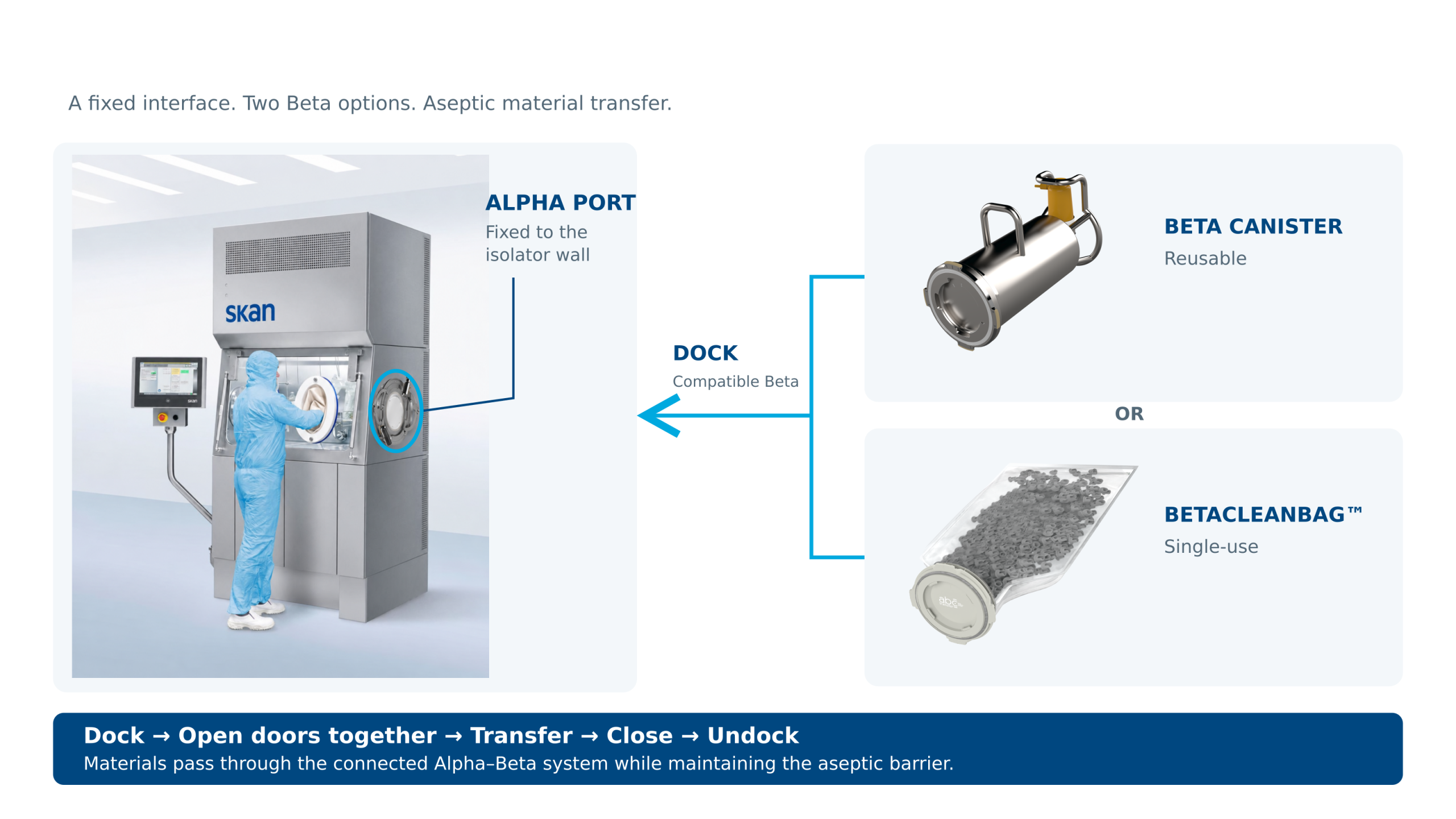
A conventional Alpha–Beta Rapid Transfer System consists of two main components:
Together, these components enable material transfer while maintaining the intended separation between controlled environments.
When evaluating RTP components from different manufacturers, it is important to distinguish three concepts.
Mechanical compatibility refers to the ability of two specified components to connect and perform their intended mechanical movements.
This includes docking, locking, door coupling, opening, closing and undocking.
However, a successful mechanical connection does not automatically demonstrate that the assembled system will perform reliably under all operating conditions.
Functional compatibility goes beyond the physical connection.
It considers whether the complete assembly performs its required functions under defined conditions, including the integrity of the interface, the effectiveness of safety mechanisms and the reliability of the operating sequence.
Interchangeability concerns whether an alternative component can replace an existing one within a defined and approved configuration without compromising the required performance.
This requires appropriate technical evidence and consideration of the intended application.
These three concepts provide a practical framework for assessment rather than formal regulatory definitions.
The key takeaway: components that connect mechanically are not necessarily interchangeable, and evidence supporting one configuration cannot automatically be extended to another.
One of the first characteristics considered when evaluating RTP compatibility is the nominal diameter.
Although diameter is an important starting point, it does not provide sufficient evidence of compatibility.
The performance of an Alpha–Beta interface depends on several interacting design characteristics.
Even when two components share the same nominal diameter, variations in geometry, manufacturing tolerances or alignment may influence their interaction.
An appropriate assessment should consider whether the specified components can connect consistently and operate as intended.
Seals are critical elements of the RTP interface.
Their geometry, material properties, compression and interaction with adjacent surfaces can influence the integrity of the assembled configuration.
A successful docking operation alone cannot demonstrate adequate sealing performance.
The opening and closing sequence must function reliably.
The assessment should consider the correct engagement of coupling mechanisms, locking systems and applicable safety interlocks throughout the operating sequence.
Connection forces, repeated docking cycles, component wear and potential particle generation may also affect performance.
These factors become particularly important when evaluating equipment intended for frequent or long-term use.
Beyond the mechanical interface, the assessment should consider how materials move through the transfer system and whether the configuration supports the required contamination control measures.
Protective accessories, transfer procedures and operator interactions may all influence the overall performance of the process.
RTP compatibility must therefore be assessed at the level of the complete configuration, not simply by comparing individual component dimensions.
The revised EU GMP Annex 1 places particular emphasis on contamination prevention, risk management and the implementation of an effective Contamination Control Strategy (CCS).
Although Annex 1 does not establish a universal compatibility requirement between RTP manufacturers, its principles are directly relevant to the evaluation of aseptic transfer systems.
Annex 1 requires manufacturers to establish a comprehensive CCS that identifies and controls potential sources of contamination.
Material transfer operations represent an important consideration within this strategy.
When evaluating an alternative RTP configuration, manufacturers should determine whether the proposed system supports the contamination control objectives established for the process.
Section 4.18 of Annex 1 addresses the risks associated with transferring materials into and out of barrier systems.
The design and operation of transfer systems should support the required protection of the critical environment.
For RTP configurations, relevant considerations may include:
EU GMP Annex 15 provides a framework for qualification, validation and change control.
Introducing an alternative RTP component may represent a change requiring documented evaluation within the pharmaceutical quality system.
The extent of qualification or validation should be determined according to the nature of the change, the available evidence and the associated risks.
Existing technical documentation may support this assessment, but its applicability to the proposed configuration must be established.
GMP compliance is not demonstrated simply by selecting components from the same manufacturer or from different manufacturers. It depends on the suitability and control of the complete system within its intended application.
A structured, risk-based approach can help manufacturers make informed decisions.
The following considerations provide a framework for technical assessment. They do not constitute a universal qualification or test protocol.
Before evaluating compatibility, clearly identify the proposed transfer configuration.
This includes:
This information establishes the boundaries of the assessment and helps determine which existing technical evidence may be relevant.
Technical documentation is an essential starting point.
Relevant information may include:
The objective is to identify what has already been demonstrated and what remains to be verified.
A general compatibility statement should never be interpreted as evidence covering every product reference, revision or operating condition.
The complete operating sequence should be considered, including docking, locking, opening, material transfer, closing and undocking.
The assessment should address the reliability of the connection and any applicable safety mechanisms.
Where additional testing is required, the methods and acceptance criteria should be appropriate to the intended application and identified risks.
Mechanical compatibility and leak-tightness are important aspects of RTP performance, but they do not independently demonstrate the aseptic performance of an entire transfer process.
An integrity test provides evidence of leakage performance under specified test conditions.
A broader contamination control assessment may also need to consider:
The extent of this assessment should be justified according to the process and its contamination risks.
Initial performance is only one aspect of equipment suitability.
Repeated connections, processing exposure, storage conditions and maintenance activities may influence component performance over time.
Manufacturers should consider whether the available evidence adequately supports the intended operating conditions and service life.
Inspection requirements, component replacement and changes in product design should also be addressed.
Once a configuration has been evaluated and approved for its intended use, the permitted component combinations should be clearly documented.
An approved configuration list may identify specific Alpha and Beta references, revisions and required accessories.
Associated procedures should address operator training, equipment inspection, maintenance and change control.
This helps prevent unintended component combinations and supports consistent operation over time.
Pharmaceutical manufacturing facilities frequently evolve in response to new products, technologies and operational requirements.
As a result, manufacturers may need to evaluate RTP configurations involving equipment from different suppliers.
Several situations can lead to such an assessment.
When modernizing a production line, manufacturers may wish to retain suitable existing equipment while introducing new transfer solutions.
Evaluating compatibility can help determine whether the proposed changes are technically feasible and appropriate for the application.
New products or manufacturing processes may require different containers, transfer accessories or handling solutions.
An assessment of available RTP options can help identify configurations that meet the required operational and contamination control criteria.
Supply continuity is an important consideration in pharmaceutical manufacturing.
Assessing alternative equipment options may form part of a broader supply chain strategy, provided that the technical and quality requirements can be demonstrated.
Ergonomics, handling constraints, equipment integration and process efficiency may also motivate the evaluation of alternative configurations.
In every case, potential benefits should be considered alongside qualification requirements, technical support arrangements and lifecycle management.
The objective is not to combine manufacturers for its own sake, but to identify a technically justified solution that meets the needs of the pharmaceutical process.
Combining RTP components from different manufacturers is not inherently unsuitable, but it requires careful consideration of the complete interface.
One important challenge is the availability of technical information.
Individual suppliers may provide evidence relating to their own products without having evaluated every possible combination with equipment from other manufacturers.
It is therefore important to establish the precise scope of any available compatibility evidence.
Responsibilities for technical support, troubleshooting and communication of design changes should also be clearly defined.
Manufacturer instructions, documented restrictions and applicable warranty conditions should be reviewed.
Technical suitability and manufacturer endorsement are separate considerations.
Demonstrating compatibility for a specific configuration does not necessarily mean that every supplier involved has approved or endorsed that combination.
From an operational perspective, introducing additional configurations may also increase the complexity of equipment identification, inventory management, maintenance and operator training.
These considerations should form part of the overall risk assessment.
Before introducing a mixed-manufacturer RTP configuration, pharmaceutical manufacturers should be able to answer the following questions:
A positive answer to one question does not replace the need to address the others.
The purpose of this checklist is to support a structured evaluation and identify areas requiring further technical investigation.
Potentially, yes. However, suitability must be demonstrated for the specific components and intended application. A successful mechanical connection alone is not sufficient evidence.
No. Components with the same nominal diameter may differ in interface geometry, tolerances, sealing arrangements or locking mechanisms.
No. Mechanical compatibility is only one aspect of the assessment. Integrity, functional performance and contamination control must also be considered according to the intended application.
EU GMP Annex 1 does not establish a general prohibition on combining RTP components from different manufacturers. Its requirements focus on contamination prevention, appropriate equipment design, risk management and control of the manufacturing process.
Any proposed configuration must be evaluated against the applicable GMP requirements and the specific conditions of use.
Not necessarily. The required qualification or validation activities should be determined through a documented change-impact assessment.
Existing evidence may remain applicable, while additional testing or qualification may be necessary where gaps are identified.
Not automatically. Extending existing results requires a documented technical justification demonstrating that the evidence remains applicable.
At ABC Transfer, part of the SKAN Group, we believe that selecting the right aseptic transfer solution begins with a thorough understanding of the process, its technical requirements and its contamination control challenges.
Combining ABC Transfer’s expertise in Rapid Transfer Port technologies with SKAN’s extensive experience in aseptic processing and isolator technology, we aim to support pharmaceutical manufacturers in making informed, evidence-based decisions.
Our approach is guided by a simple principle: the suitability of a transfer solution should be demonstrated through technical evidence, risk assessment and an understanding of its intended application – not determined by brand alone.
Contact the ABC Transfer team to discuss the technical considerations relevant to your application.