18 September 2026
| update5 mins
Read more
Understanding their roles and selecting an integrated solution
Restricted Access Barrier Systems (RABS) and isolators protect the aseptic processing environment. Rapid transfer ports (RTPs) control a specific interface through which materials enter or leave that environment. They therefore address different parts of the same manufacturing challenge and can be used together.
Choosing an effective combination starts with the process: what will be exposed, which interventions are unavoidable, and how materials will reach their point of use. Looking at these questions early helps prevent a transfer requirement from becoming a late equipment modification.
A RABS uses physical barriers and controlled airflow to restrict operator access to the critical processing area. Glove ports allow interventions while the barrier doors remain closed. Its operating concept is closely linked to the supporting cleanroom and the procedures used for set-up, disinfection and access.
An isolator creates a more extensively separated processing environment, with engineered transfer interfaces and a defined internal bio-decontamination process. This separation can reduce dependence on the surrounding room, but its effectiveness still depends on the enclosure, glove system, transfer routes and operating practices.
Open and closed isolators describe different transfer and separation concepts. An open isolator can have engineered openings for material movement with airflow protection. It does not mean that operators may routinely open the main doors during aseptic processing. Equally, a closed RABS is not automatically an isolator: the overall design and operating concept determine the distinction.
While these technologies complement each other, they serve distinct purposes. The following overview highlights their specific functions and the critical questions to ask during equipment selection:
For aseptic processing, EU GMP Annex 1 section 4.20 specifies a minimum Grade B background for RABS. Open isolators should generally have at least Grade C; closed isolators should have at least Grade D. Isolator background classification requires risk assessment and justification in the CCS, and additional risks may warrant a higher grade. See Annex 1 section 4.20.
These distinctions should inform the facility concept early. Installing a transfer port does not change the classification basis of the surrounding system.
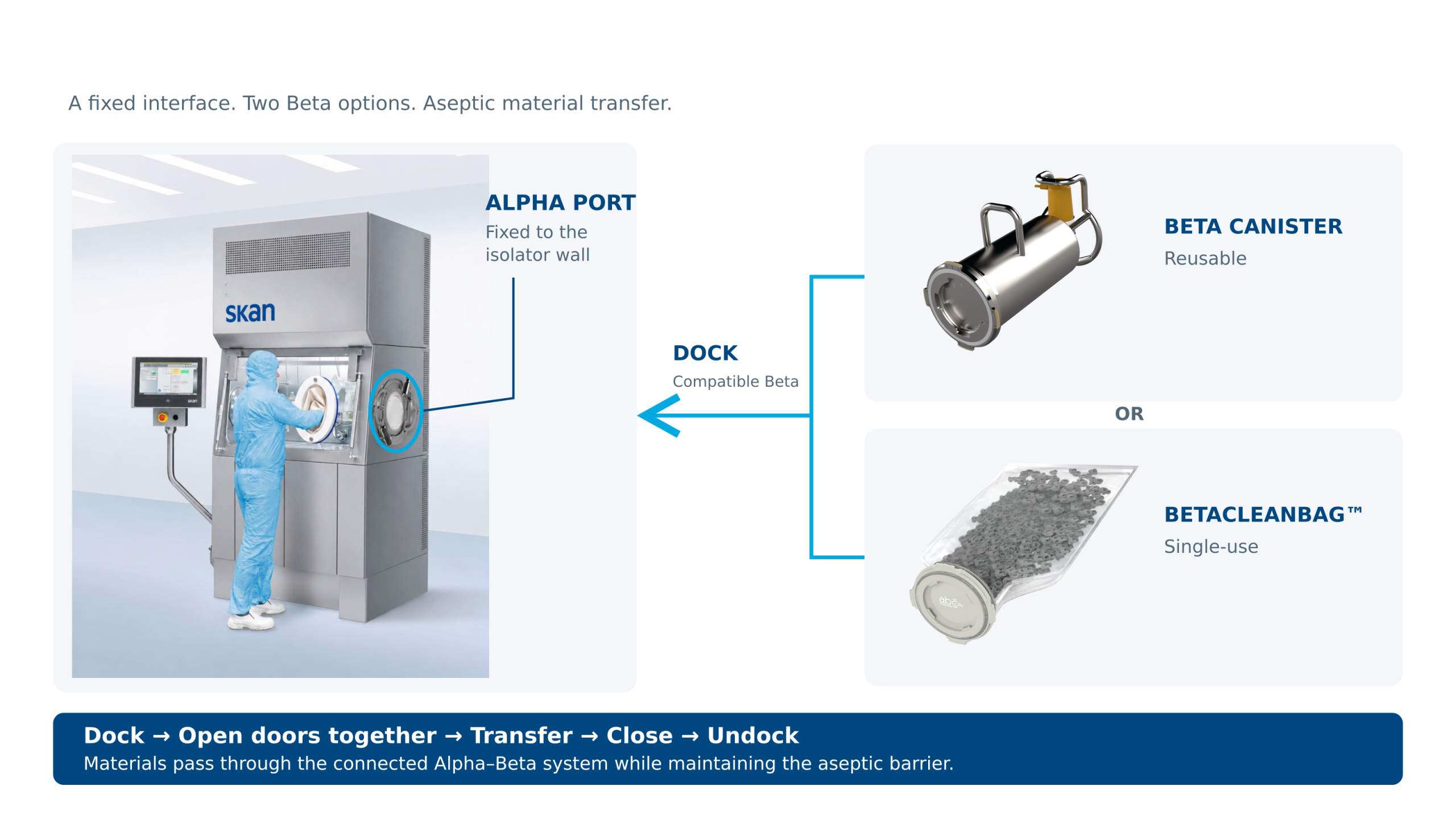
An RTP connects a fixed Alpha assembly to a mobile Beta assembly such as a canister or ported bag. It can provide a replenishment or removal route that avoids opening the main enclosure. Suitability depends on the barrier design and on what happens on both sides of the connection.
For example, feeding prepared components into a filling line requires more than an available wall opening. The project team also needs space for docking, support for the load, access to operate the port and an internal route to the receiving equipment. A technically suitable interface can still be impractical if the operator must stretch across another critical operation.
Some items will need another route. Large machine parts, awkward geometries or materials needing a dedicated preparation step may be better served by a different transfer arrangement. A facility can therefore combine RTPs with other qualified transfer technologies rather than forcing every item through one interface.
Describe set-up, replenishment, sampling, fault recovery and removal activities. For each task, identify who performs it, what is exposed and where the operator needs access. This exercise makes the practical differences between candidate equipment concepts visible.
Aseptic product protection aims to prevent contamination reaching the product. Hazardous material containment aims to prevent exposure of people and the environment. Some processes need both. An aseptic transfer design should not be assumed to provide the required exposure control without evidence for the material, pressure arrangement and operating sequence concerned.
A large port or fast filling machine does not by itself establish production capacity. Include preparation, docking, transfer, disconnection, replenishment and changeover in the assessment. Where canisters are reused, include their return, cleaning and preparation cycle. Where betabags are single-use, include supply, storage and waste handling.
Review how seals and other wear parts will be inspected and replaced, and whether a trolley can approach the port without obstructing another task. Consider both routine production and maintenance access. Small layout decisions can otherwise create recurring interventions or awkward handling throughout the equipment lifetime.
Agree which questions the equipment supplier will answer and which require testing at the manufacturing site. Build the transfer interfaces into the user requirements specification, with the intended configurations and loads clearly identified. This gives engineering, validation and production teams a common basis for design review.
A practical review can trace one representative item from preparation to use and identify the evidence at every step. Is its required condition established? Is its packaging suitable for the handling route? Can the correct Beta assembly be identified? Can the load pass through the interface without unintended contact? What happens if transfer is interrupted?
Use challenging but credible scenarios when evaluating the design: the heaviest canister, an awkward item, limited operator reach or the maximum planned replenishment frequency. Record the assumptions, test the selected configuration and feed the findings back into the operating instructions.
For the detailed transfer-control questions behind this approach, read our companion article on rapid transfer ports and EU GMP Annex 1.
ABC Transfer provides Alpha Ports and single-use Betacleanbags™ for aseptic transfer applications. Selecting the appropriate configuration begins with the material route, required preparation method and barrier integration. Involve the transfer-system supplier alongside the barrier-equipment team while these choices are still open.
No. An isolator provides the processing enclosure. A RTP provides a transfer interface that can be integrated into a suitable enclosure.
Yes, where the RABS design supports it and the complete transfer process is shown to be suitable. A RTP does not turn a RABS into an isolator.
No. Selection needs to account for the product, interventions, material routes, facility constraints and required protection. The justification should address the integrated process rather than the equipment name alone.
Developing a new line or upgrading a transfer route? Explore ABC Transfer® Alpha Ports and share your barrier concept, load characteristics and operating requirements with our team.